BT Connectivity is so terrible today, that even in Fishguard Harbour with a decent mobile signal, it takes ten minutes to log into Google, and half an hour to get this far with posting to Blogger. It's been the same for the past four days. Awful. Ah, but this is Pembrokeshire. People smile in resignation. Unacceptable for the Welsh economy.
This evening, I picked up a signal in Aberteifi on the way home. Now it only takes 2-3 minutes to load a Blogger page. All so that I could replace badly formatted text uploaded earlier with correctly formatted text. So I hope it's more readable now.(Photos inserted on return to home and a functional connection)
09/08/13
We went into Aberteifi mid morning and sat in Guildhall's Oasis Cafe, where a good BT Openzone signal was available, and spent half an hour email checking and blog updating with a tiny selection of the three hundred odd photographs taken since our arrival. Then we bought some sandwiches for lunch from the Coop supermarket down by the riverside car park and ate them on a park bench. Tomorrow the entire car park will be given over to a Teifi river and food festival, but where we'll be able to part if we want to visit is anyone's guess.
We then drove up the south side of the Teifi river valley to Cilgerran, a village with the ruins of a modest sized mediaeval castle on a promontory overlooking the wooded river gorge. First we looked around the Parish church, a largley Victorian re-build with a mediaeval tower on an ancient site, maybe 8th-9th century. Its original dedication was St Brynach, an Irish hermit monk who crossed the sea and presumably travelled up the Teifi in the first instance, leaving his name a hundred miles further on in the dedication of Llanfrynach church outside Cowbridge in the Vale of Glamorgan.
In this St Brynach churchyard, a small standing stone is located in among the graves with lettering in Irish and Latin, like the one in nearby St Dogmael's church. It's an impressive reminder of the close religious and cultural ties between Ireland and Wales, and the rerst of Western Europe, going back 1500 years or more.
We then visited the castle a few hundred yards away tucked in behind the main street of houses, looked around.
Then we descended to the riverside where there's a coracle sailing centre. There's a walkable riverside footpath, made interesting by the remains of slate quarries which have been largely reclaimed by the woodland, so the environment doesn't look as scarred as the landscape in other parts of Wales where slate was once extracted.
Inland the Teifi served as a communications artery and Aberteifi was in the nineteenth century a busy port with three hundred registered ships, taking out slate, bricks manufactured locally, and even tin-plate, as there were also small iron foundries and tinplate works in the alley since early in the industrial revolution, if not earlier. In this respect, it's very much like the Wye Valley used to be right over on the eastern border of Wales. Industrial growth in other strategic centres resulted in the decline of the Teifi, like the Wye during the twentieth century. They have returned to being quiet rural areas, busy only with tourists.

After our riverside stroll, we called in the Cardiff Arms pub for a drink. It has an old coracle mounted on the wall outside, and its notice board advertises fresh sewin (a large sea-trout) still caught in the Teifi below the village. Tea for Clare, and two choice half pints of different Felinfoel ales for me. We stopped in St Dogmael's on the way back to walk around the Abbey grounds, as Clare had not yet done so. She didn't get her scone jam and cream at the Cardiff Arms in Cilgerran, but the Abbey visitor centre obliged deliciously.
10/08/13
We made our way into Aberteifi just after ten this morning, in search of a place to park, and found a spot in the trading estate on the south side of the river, less than half a mile from the car park site of the Teifi River and Food Festival. The upper and lower levels of the car park were filled with stalls, mostly small food producers from all over West Wales, promoting their wares or simply selling freshly cooked food and drink. It shows the extent to which the niche market for locally sourced traditional recipe, hand made (as opposed to industrially mass produced) food has developed in recent decades. Real ale, cider, country fruit wines liqueurs and spirits, cheese, sourdough breads, pickles, chutneys, jams, sausages, dried meats, boar, venison - an impressive array of well presented offerings.

There was a stage and a covered area with tables for people to sit and eat while watching performances of music and dance on stage. Radio Ceredigion was there animating the event. Several charities had stalls including the local lifeboat station. There was even a St Mary's Parish Church tent offering hospitality and things for kids to do.
On the river, there was a race between sea going longboats, high sided craft like the ones I last saw on the river Nervion in Bilbao five years ago, with four rowers and a coxswain.
The local RNLI team demonstrated the speed and manouverability of its latest craft and simulated a rescue with one of its own crew from the water, armed with an emergency flare to aid positioning.
Finally, before the duck race, seven middle aged men in coracles came down river and messed about in front of the crowds, punting a yellow plastic float around between them using their oars like hockey sticks, while showing how quickly their small craft could manoeuvre, and stay in position against a running tide.
The weather was warm and sunny in the morning and became cool and cloudy in the afternoon.Light showers didn't arrive until we got back to the cottage. We thought the festival was busy in the morning, but it became even busier in the afternoon, perhaps because the beach became less congenial a place to be, and the opportunities for interesting food grew more attractive. Radio Ceredigion declared it was the best weather ever since the festival began four of five years ago.
Returning to Moylegrove, we went in search of the village church, up a steep hill and narrow lane on the east side. We'd been told it was de-consecrated, but to my eye it was simply closed and not in use. It was in good repair, but the churchyard hadn't been mowed this year.
Peeping in through the windows, I could see churchwardens' staves still in place, hassocks in pews and a hymn board on the wall. Services may no longer be held here, not merely because they cannot be sustained pastorally, but because the larger parish it is now part of has no incumbent or is in the throes of being re-organised.
Maybe a Deed of Closure has been issued so that legally authorised weddings can no longer be performed there. That's as good as dead, but the estate has yet to be disposed of, and that always takes time, as I still recall painfully from having to oversee the closure and disposal of St James' Church effects in my last years as a Vicar. I don't envy anyone having to perform that task. In a village which may now contain very few people with any residual interest in the building and its content, that can be an extra difficult task, knowing that some will talk about what's happening but nobody wants to help.
11/08/13
We went to the Parish Eucharist at St Dogmaels again this morning. A different retired priest presided and preached. He mentioned St Clare, as it's St Clare's Day, and went on for too long about top charity executive salaries in a way that reflected newspaper editorials rather than analysing the truth of an issue stirred up by a government minister, who to my mind seems to be sniping at charities that lobby for change in government policy, and raise debates that embarrass the powers that be. Things are never as simple as the media make them out to be.
After the service we drove over the the Cilgerran wildlife centre where a lunchtime open air poetry reading session was taking place.
We arrived late, but caught two thirds of it. Prominent Welsh language poet Menna Elfyn was guest of honour. She writes in Welsh, but also translates her own work and the work of other poets into English, and her poetry performances are bi-lingual.
Impressively beautiful to listen to in both languages. I understood the English and only partly understand the Welsh, but the music of both languages appeals greatly.
We walked a mile up the Teifi gorge after the performance, and then drove back to Moylegrove by way of Nevern where we visited St Brynach's Parish Church, with its weeping yew trees and remarkably well preserved 8-9th century Celtic cross in the churchyard.
It's an enchanting village with a stream that runs into the river Nevern, meadows and wooded hillsides.
There's been no resident priest here since 2007 when the Georgian Vicarage next to the church was sold. There's still a regular Sunday Eucharist, but I couldn't work out from the notice board which pastoral grouping it belongs to. Later I learned that it is now served from St Dogmael's. The last time I visited here was about 25 years ago, visiting the incumbent in his capacity as Rural Dean of the locality. Everything now looks a lot smarter and better tended. You have to be wealthy to afford to live here and maintain a place in a village as charming as this.
12/08/13
In a field on a hill by the roadside a mile out of St Dogmael's today the Pembrokeshire Association sheepdog trials event took place. Rain stayed away and despite the breeze coming from the sea it was tolerably warm enough for scores of spectators - farmers, shepherds, local residents and holidaymakers - to stand around socialising and enjoy the great outdoors without shivering. It was lovely to hear people chatting in both Welsh and English, switching naturally from one to the other.
As well as West Walian accents, I heard people speaking with English, Canadian and Australian accents. There were French and Italian speakers too. On family had come over from Belgium with their sheepdogs to take part. The competition cup was won by the Italian shepherd and his dog. So it was truly an international event. Most of the shepherds were older men, but there were several women, including a fourteen year old girl taking part. She and her dog did well, and earned the approving applause she got after her second trial.
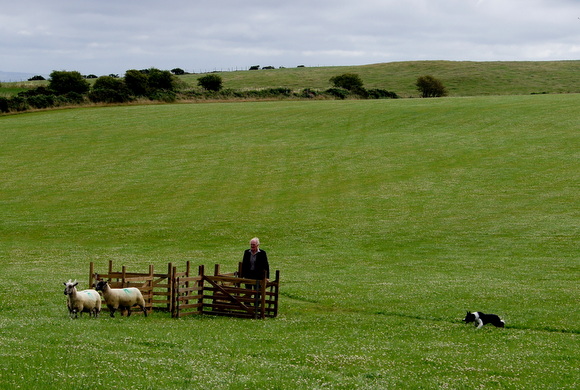
At the top of the hill, a third of a mile away, there was a livestock pen where the sheep used for the trails were held until needed. Two shepherding competitions took place. One was based on herding three sheep and the other four. A group of animals were released and the start signal given by the referee. In eight minutes, the sheepdog had to sprint up the hill, drive the creatures down the hill through a couple of pairs of gates and into the area where the shepherd waited, whistling or shouting commands to the dog. Then dog and shepherd worked at close quarters to send the sheep first through a narrow gate and finally into a pen. It was clearly not an easy exercise, even for very experienced shepherds and fascinating to watch.

The interior of a large cattle wagon was equipped as an improvised field kitchen, offering tea, coffee and sausage or bacon rolls. A couple of ladies who'd welcomed us into St Dogmael's church congregation were there cooking and serving and enjoying this important local community event.
In the afternoon we went into Aberteifi to re-fuel the car and stock up on food. I tried to get on-line in a place where there was good BT Openzone wifi and mobile signal reception but was unable to log in on either service. Failure to recognise browser memorised passwords going on for long periods of time is a symptom of chronic congestion at a local network server level - not a problem with the equipment being used. It happens in Cardiff too on Big Match days.
It happens in rural Wales due to lack of spare capacity to meet the extra connectivity needs of huge numbers of holidaymakers, many of whom will bring with them more than one internet capable devices. A few days ago the BT Openzone service in town was easily accessible and very fast. Today, I gave up trying, annoyed and frustrated after more than half an hour of error messages. Delivery simply doesn't match the advertised promise, whatever the marketing people say.
Before returning home with the shopping, we drove out to the Mwnt, walked on the beach, looked in the church and climbed 180 feet up on to the slate outcrop that overlooks the shore. The view of the coast and Cardigan Bay from there is magnificent. Best of all, the Mwnt area is National Trust property, so our membership windscreen sticker got us a place in the car park for free.


